Reviewed by the Cuepaw Editorial Team
Last Updated: June 2026
Written by the Cuepaw Editorial Team
If you've just unboxed an e-collar for agility work and you're staring at a dial that goes from 0 to 100, here's the short answer: most working dogs respond at stimulation levels between 4 and 15 on a 100-point scale, and your job in the first two weeks is to find that exact number for your specific dog before you ever pair it with an agility cue. Get that wrong, and you'll either get a dog that ignores the collar or one that shuts down on the start line. Get it right, and the collar becomes a feather-light tap on the shoulder mid-course.
This guide walks through how to find that working level, how to apply it on agility equipment, and the mistakes that quietly ruin good dogs. The training collar stimulation levels agility handlers actually use are far lower than most beginners assume.
The Problem: Why Most Beginners Set Levels Way Too High
Walk into any agility club and you'll hear the same complaint: "The collar isn't working, I had to crank it up to 40." Nine times out of ten, the handler skipped the working-level test and went straight to a number that felt like it should do something. That's backwards.
A training collar isn't meant to startle or punish during agility. It's a tactile attention cue, similar to a tap on the shoulder when a runner zones out. For the contact zones, weave entries, and tunnel discrimination work where you'll actually use it, you want the dog to notice the sensation, not react to it. The visible tell is an ear flick, a slight head turn, or a tiny lip twitch. Nothing more.
When levels run too high, three things go wrong in agility specifically. Dogs hesitate at the start line because they associate the field with discomfort. They pop weaves looking for the source of the stimulation instead of focusing on the next obstacle. And they slow their contacts, costing course time that no amount of retraining easily recovers.
Step-by-Step: Finding Your Dog's Working Level
This process takes 15 to 20 minutes in a quiet, distraction-free space. Do it before your dog has done any agility that day, not after a run when adrenaline is masking sensation.
- Fit the collar properly. The contact points must touch skin, not just sit on top of fur. For most agility breeds, the collar sits high on the neck just behind the ears, snug enough that you can fit one finger underneath but no more. Loose contacts give false negatives and you'll wrongly conclude your dog needs a higher level.
- Start at zero and increment by ones. Set continuous stimulation (not momentary) at level 1. Press the button for about one second while watching your dog's face and ears. No reaction? Go to level 2. Repeat.
- Watch for the recognition response. You're looking for the smallest visible acknowledgment: an ear twitch, a head tilt, a glance toward you, a single sniff. That's the working level. Write the number down.
- Confirm twice more. Wait 30 seconds, then test that same number again. Then go down one level and confirm the dog does not respond. This brackets your working level precisely.
- Test on the agility field. Outdoor environments, especially with other dogs nearby, often require 1 to 3 levels above the indoor working level. This is your field working level, and it's the number you'll actually use.
Agility Collar Intensity Settings: What Each Mode Does
Modern e-collars have three primary modes, and each has a place in agility training.
- Continuous stimulation at the working level is used for attention prompts during sequencing. The button is pressed for less than half a second, just long enough for the dog to acknowledge.
- Momentary (or nick) delivers a brief pulse regardless of how long you hold the button. This is what most agility handlers use for weave pole proofing and contact criteria.
- Tone or vibration is the no-stim option that many handlers use for recall during a course. Pair this with treats during the foundation phase so it predicts something good.
Tools You'll Need
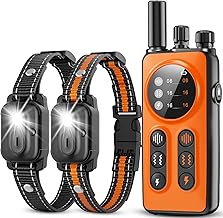
For low level stimulation training in agility, the collar itself matters less than precision. Look for these specifications when shopping, and use them as your filter regardless of brand.
- At least 100 stimulation levels. A 0-to-16 collar is too coarse for agility precision. You need the granularity to land between two adjacent settings.
- Waterproof receiver rated IPX7 or higher. Agility happens in rain, on wet grass, in mud.
- Range of at least 1/2 mile. You don't need it for the course, but reliable signal at short distances matters more on collars with strong long-range specs.
- Receiver weight under 3 ounces. Anything heavier interferes with jump form and tunnel speed on smaller dogs.
- Short and long contact posts in the box. Coats vary even within a single breed.
- Lockable buttons. Pocket-pressing the wrong button mid-run is a real problem at trials.
Tips for Best Results
Keep sessions under 10 minutes during the working-level discovery phase. Dogs habituate to repeated low-level stim if you drill it, and you'll falsely conclude the working level has drifted upward.
Recharge the collar before every training day. A low battery delivers inconsistent stimulation, and that inconsistency is what creates collar-wise dogs that perform at home but ignore the system at trials.
Always pair the stimulation with a verbal cue the dog already knows. The collar is a backup channel, not the primary instruction. On contacts, my sequence is verbal "touch" first, then collar tap only if the dog is committing to leave early.
Log your levels. Write down the working level each session for the first month. Patterns emerge: many dogs need a slightly higher level in cold weather and after long layoffs, and a slightly lower level in summer heat.
Common Mistakes to Avoid
- Cranking the level up because the dog "isn't responding." First check contact-to-skin, then battery, then collar fit. The level is almost never the issue.
- Using stimulation to stop the run. The collar should redirect, not punish. A dog that gets stim for going off course learns to refuse obstacles.
- Skipping the field re-test. Indoor working level is rarely the same as field working level.
- Sharing the collar between dogs. Each dog has a unique working level. Label the remote channel for each dog if you have a multi-dog system.
- Using the collar before foundation training is solid. The collar reinforces what the dog already understands. It does not teach new behaviors.
Related Resources
For handlers new to agility equipment, the foundation work on contact behaviors and weave entries needs to be solid before introducing any collar. Refer to your local club's beginner curriculum, and consider working with a trainer certified through a recognized agility organization before progressing to advanced proofing.
Final Verdict
Finding the right stimulation level for agility is about precision, not power. Start at zero, work up by ones, and stop the moment you see the smallest acknowledgment. The number you land on will likely surprise you with how low it is, and that's exactly the point. Used correctly at the working level, a training collar becomes the quietest, most consistent communication tool in your agility toolkit. Used incorrectly, it ruins dogs faster than almost any other piece of equipment in the sport.
Frequently Asked Questions
Most dogs work at levels between 4 and 15 on a 100-point scale. The exact number is unique to each dog and must be found through a stepwise working-level test, not guessed.
Can I use an e-collar on a puppy doing agility foundations?
No. E-collars should be introduced only after a dog is physically mature (typically 12 to 18 months depending on breed) and has solid foundation obedience. Foundation agility on jump bumps and flat tunnels needs no collar at all.
Is vibration safer than stimulation for agility?
Not necessarily. Some dogs find vibration more startling than low-level stim. Test both during your working-level discovery and use whichever produces a calm acknowledgment rather than a startle response.
How often should I re-test my dog's working level?
Every 4 to 6 weeks during active training, and any time you notice the dog responding differently to the same setting. Working levels drift with conditioning, weather, and the dog's stress state.
Why does my dog seem to ignore the collar at trials but respond at home?
Usually one of three things: arousal at trials genuinely raises the working level, the collar fit shifted during warm-up, or the battery dropped below the consistent-output threshold. Check all three before raising the level.
Can I leave the collar on between agility runs?
No. Continuous wear of any e-collar should be limited to active training sessions of under an hour. Remove between runs to prevent contact-point irritation.
Does the collar replace my voice on a course?
Never. The collar is a redundancy channel for moments when verbal cues alone aren't reaching the dog. Voice, body position, and motion remain the primary handling tools.
Sources & Methodology
Working-level ranges referenced in this guide are drawn from published e-collar manufacturer training manuals, peer discussion within agility handling communities, and observed practice at AKC and USDAA sanctioned trials. Equipment specifications listed under buying criteria reflect industry standards as of 2026. This guide is informational and is not a substitute for hands-on instruction with a certified trainer familiar with your specific dog.
About the Author
The Cuepaw editorial team researches products in the dog training and agility category using the manufacturer's published specifications and Amazon's official product data for each listing. We do not physically test, own, or use these products, and we do not systematically read customer reviews; our guidance reflects the published specs and listing details compared against current industry standards. For real-world performance, check recent owner reviews yourself before buying.
Key Takeaways
- Choosing the right training collar stimulation levels agility means matching the key features to your specific needs and budget
- Read real customer reviews and check the return policy before you commit
- Also covers: finding working level e-collar
- Also covers: agility collar intensity settings
- Also covers: low level stimulation training
- Compare value across models — the priciest option is not always the best fit


