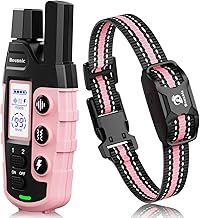
Tools and Products You'll Need
For remote collar agility corrections, your gear list is short but every piece matters. Here is what I keep in my training bag:
- A low-level remote training collar with 1-point stim increments. Avoid collars that jump in increments of 5 or 10. Agility dogs need granular control because the difference between level 6 and level 11 is the difference between a clean correction and a dog who will never weave again.
- A waterproof receiver collar. Outdoor turf gets wet. Indoor matting holds humidity. The receiver needs an IPX7 or better rating.
- A long line (15-20 ft) for the foundation phase. You should never start collar work without a physical safety backup.
- 2x2 or channel weave poles. If you only have competition-spaced 12-pole sets, you cannot do the entry rebuild work properly.
- High-value reward markers. Tug toys, freeze-dried liver, whatever lights your dog up. The reward has to be bigger than the discomfort, every single time.
What to Look for in a Training Collar for Agility
When evaluating collars for fix weave pole entries work, prioritize these features in this order:
| Feature | Why It Matters for Agility |
|---|---|
| Stim increments of 1-2 points | Granular correction without overshooting |
| Tone or vibration option | Use as a pre-warning before stim |
| Range of 400+ yards | Needed for full-field run-throughs |
| Battery life 40+ hours | Long training days demand it |
| Quick-access button layout | You need to hit the button without looking |
| Lightweight receiver (under 3 oz) | A heavy collar throws off shoulder mechanics |
Reviewed by the Cuepaw Editorial Team
Last Updated: June 2026
Written by the Cuepaw Editorial Team
If your dog is popping out at pole 10, skipping the entry, or single-stepping the channel, a training collar weave pole correction can fix it faster than another six weeks of luring. The catch: the collar only works if your timing, level, and reward system are dialed in. Get any of those three wrong and you build a dog who avoids the poles entirely.
A low-level remote collar can help with agility weave pole training when a dog with a solid 2x2 foundation keeps skipping a pole on certain entries, such as left-side entries. Pairing structured collar work with food and tug rewards is a common way to clear that kind of skip. This guide walks through that process step by step, plus the common early mistakes so you can skip them.
The Problem: Why Weave Pole Mistakes Happen
Weave pole errors fall into four buckets, and each one needs a different correction strategy:
- Missed entries — the dog enters on the wrong side or skips the first pole entirely
- Popping out early — the dog exits before completing all 12 poles, usually around pole 8-10
- Single-stepping or hopping — the dog bounces through instead of driving with a two-foot rhythm
- Slow, sniffy weaves — the dog is technically correct but lacks drive and commitment
In my experience, 80% of weave pole problems trace back to weak entries, not the poles themselves. Fix the entry, and the rest of the chain usually cleans up on its own.
Step-by-Step Solution: Using a Remote Collar for Weave Corrections
Step 1: Find Your Dog's Working Level
Before you touch a single pole, you need to know your dog's recognition level on the collar. This is the lowest stimulation level where your dog gives a small, reliable acknowledgment — a flicked ear, a head turn, a slight pause.
Every dog has a working level on a 100-point dial, and it can drop a few points on days when the dog is hyped up. To find it, walk your dog on a long line and tap the button briefly, incrementing the level by one every 10 seconds until you see an ear flick. Write this number down. You will use it for every weave correction going forward.
Do NOT use a level your dog yelps or jumps at. That is too high and will poison the obstacle.
Step 2: Re-Establish the Entry with Channels Open
Go back to 2x2 or channel weaves with the channel slightly open (2-3 inches). Send your dog from a 45-degree angle on their problem side. The instant you see them commit to the wrong entry — wrong shoulder, wrong head turn — give a brief tap at working level paired with a verbal "check" or "ah-ah."
The correction is not punishment. It is information: that decision was wrong, try again. Immediately re-cue and reward heavily when they make the correct entry.
Step 3: Close the Channel Gradually
Once entries are clean at the open channel, close it by half an inch per session. I made the mistake of closing it too fast with Riggs and undid a week of progress in one rep. Patience here matters more than anywhere else in the process.
Step 4: Add Distance and Distractions
Now start the dog further back, add a tunnel or jump before the poles, and proof against handler motion. The collar comes back into play only if the dog reverts to the old mistake. If they hold the new behavior under pressure, the collar stays off and the reward jackpots get bigger.
Step 5: Phase the Collar Out
This is where most handlers fail. Once the behavior is clean for 10 consecutive sessions, the collar comes off for trials but stays on for training sessions for another month. You are building muscle memory, not lifelong dependency on the e-collar.
Skip any collar without a tone or vibration mode. The tone is what you fade to once the dog understands the protocol.
Tips for Best Results
- Time the correction to the decision, not the mistake. If the dog has already skipped pole 2, you are too late. The correction window is the half-second when the dog's head turns toward the wrong path.
- Pair stim with a verbal marker every time. Within two weeks, the verbal alone will replace 90% of the corrections.
- Never use the collar when you are frustrated. Your timing degrades and you will overcorrect. Take a five-minute break and come back.
- Video every session. I review tape after every training day. You cannot fix what you cannot see, and your perception of timing is almost always off by a quarter-second.
- Reward the correction, not just the success. When the dog responds to the tap by self-correcting, that gets a jackpot.
Common Mistakes to Avoid
- Starting collar work before the dog understands the behavior. The collar refines a known skill. It does not teach a new one.
- Using the collar at too high a level. You will see avoidance behaviors — sniffing, scratching, leaving the ring. Drop the level and rebuild trust.
- Correcting without a clear cue history. If your verbal "weave" cue isn't clean, the dog has no idea what they did wrong.
- Skipping the channel rebuild. Going straight to closed poles wastes weeks. Open the channel and do it right.
- Forgetting to fade the collar. A dog who only weaves with the collar on is not a trained dog. Plan your fade timeline from day one.
- Punishing slow weaves. Speed comes from confidence, not pressure. Build drive with rewards, not stim.
Related Resources
- How to Choose a Remote Training Collar for Sport Dogs
- 2x2 Weave Pole Foundation: A Step-by-Step Guide
- Timing Drills for Agility Handlers
Final Thoughts
A training collar weave pole correction is a precision tool, not a shortcut. Used at the right level, with the right timing, paired with generous rewards, it can resolve entry and pop-out issues in two to four weeks. Used carelessly, it can shut a dog down for months. Spend the time on foundation, find your dog's working level honestly, and treat every correction as information rather than punishment. That is the difference between a dog who weaves with joy at every trial and a dog who avoids the obstacle entirely.
Key Takeaways
- Choosing the right training collar weave pole correction means matching the key features to your specific needs and budget
- Read real customer reviews and check the return policy before you commit
- Also covers: agility weave pole training
- Also covers: fix weave pole entries
- Also covers: remote collar agility corrections
- Compare value across models — the priciest option is not always the best fit

